
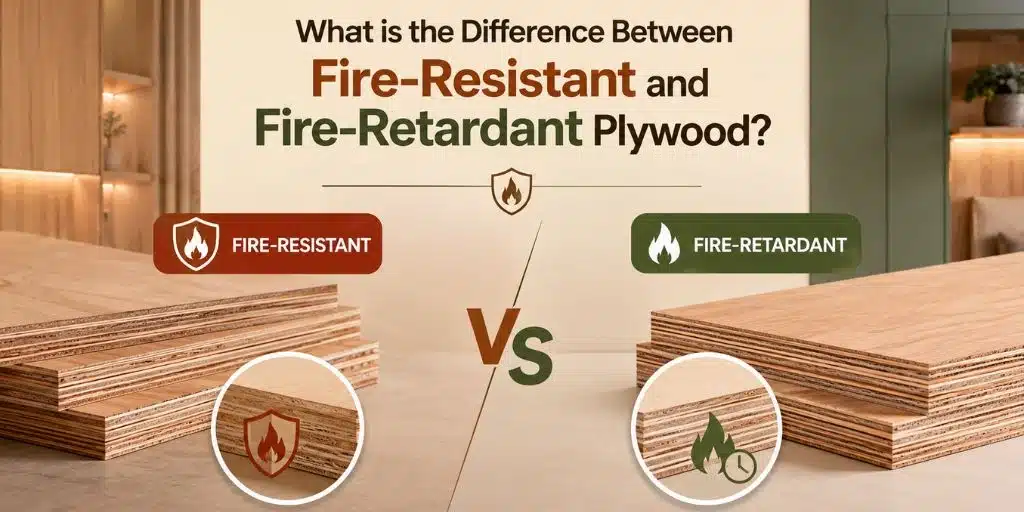
Fire safety is something that has become significant in modern architecture and the interior design industry. If you are building a house, office, hotel, hospital, or commercial centre, the selection of correct materials will help lower the fire hazards. One of the most common questions among buyers is whether to get fire-resistant or fire retardant plywood. These terms are often confused, though they do not mean the same. When you know the difference, it will be easier for architects, contractors, and home builders to make more suitable choices for safety and quality.
What is Fire-Retardant Plywood?
Fire-Retardant Plywood is produced using fire-retardant chemicals during its manufacturing. These chemicals help slow down the spreading of flames on the surface of the plywood and combustion. This type of plywood is able to prevent large accidents by not igniting immediately. It gives people more time to leave a building and firefighters to extinguish the fire. This type of plywood aims to contribute to fire safety without reducing its strength or durability. The fire retardant plywood manufacturers make them as per IS: 5509 specifications.
Fire-Resistant Plywood Overview
Fire-resistant plywood refers to plywood products created to withstand fire for some time, depending on how the products were created or certified. Such products are made so that they can stand for a certain time without losing structural integrity when exposed to fire. In practice, most fire-resistant plywood materials are so classified because of the use of fire-retardant treatments. Their purpose is not to make plywood fire-safe but to delay ignition and fire spread.
Comparing Both Plywood Types
| Feature | Fire-Retardant Plywood | Fire-Resistant Plywood |
| Purpose | Slows the spread of flames | Resists fire for a specified duration |
| Treatment | Chemically treated during manufacturing | May use special treatments or engineered construction |
| Flame Spread | Significantly reduced | Reduced while maintaining structural stability |
| Smoke Generation | Lower compared to ordinary plywood | Depends on product specifications |
| Common Applications | Homes, offices, hotels, restaurants, theatres | Commercial buildings, public infrastructure, high-risk areas |
Advantages of Using Fire-Retardant Plywood
Improved Fire Safety
Mainly because of its ability to delay fire spread, fire-retardant plywood helps people save lives during emergencies.
Less Smoke
Quality fire-retardant plywood combusts, producing much less smoke than ordinary plywood. This is useful for evacuation purposes.
Better Protection
Slow fire spread means limited damage to the furniture or other items in the building.
Suitable for High-Risk Areas
It can be used in places where electric tools, kitchens, etc. are present.
Long-term Durability
High-quality fire-retardant plywood is also resistant to termites, wood borers, and moisture when using top-quality resins and treated wood.
Choose Fire Retardant Plywood
Designers, architects or homeowners search for the fire retardant plywood Near Me to find dependable fire safe plywood for their projects. Comparing price along is not enough. Look for IS: 5509 certification and the experience of the fire retardant plywood manufacturers. Quality assurance and warranty support build confidence when purchasing.
Conclusion
While both fire-resistant and fire-retardant plywood are often referred to as the same, the difference lies in how they manage the safety of the surroundings. Fire-retardant plywood is the better and more popular choice as it is manufactured with higher standards. Kridha Laminates is one of the well-known fire-retardant plywood manufacturers, offering it in multiple sizes and variations in protection times.